SS Content Exam Website

Faith Martin ECED-4350-B01
for: Dr. Jennifer Brown
Contents

Texas history

3 facts about the Texas Revolution

  • The Texas Revolutionary War started in October 1835 and ended in April 1836.
  • It started as a rebellion between Anglo-Americans and Hispanic Texans.
  • Notable battles were the Battle of the Alamo and the Battle of San Jacinto.
What is the Republic of Texas?
The Republic of Texas was an independent nation in North America from 1836 to 1845, formed after the Texas Revolution and later annexed by the United States.

2 maps and 4 sentences of the annexation of Texas

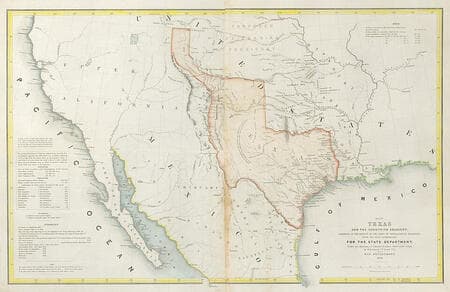
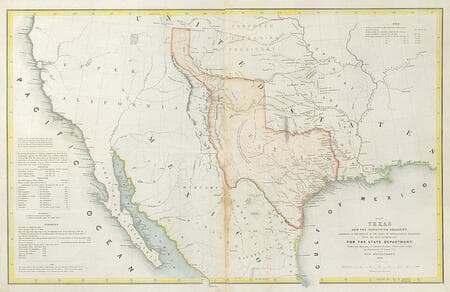
Fg. 1 William H. Emory's 1844 Map of Texas and the Countries Adjacent.
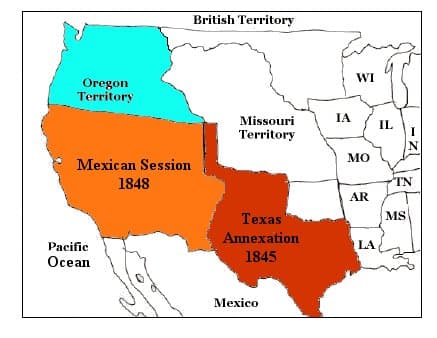
Fg. 2 The annexation of Texas in relation to other later annexed territories.

After nearly a decade of independence, the Republic of Texas agreed to be annexed by the United States in 1845, ending its status as a sovereign, solo, nation.

Texas was annexed on December 26, 1845, becoming the 28th state.

The annexation of Texas raised the tensions between Mexico and the united states.

The border dispute between the two nations directly contributed to the Mexican American war.
US history

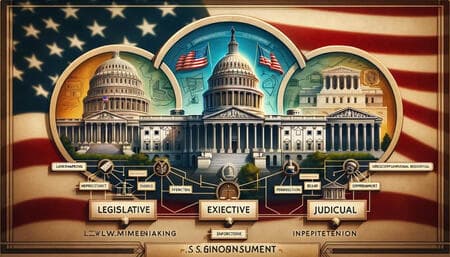
1 picture of the foundations of the representative government of the United States

Fg.3 The Structure, Roles, and Functions of the U.S. Federal Government.

2 significant individuals of American Revolution

George Washington

George Washington was the Commander-in-Chief of the Continental Army. Washington's ability to inspire and maintain the morale of his troops, even during difficult times, was instrumental in the success of the revolution.

Thomas Jefferson

Thomas Jefferson was the main author of the Declaration of Independence. Jefferson's philosophical contributions and vision for a democratic society greatly influenced the formation of the United States.

1 major event

Battles of Lexington and Concord (1775)

The first military engagements of the Revolution, marking the outbreak of armed conflict.

3 challenges the US faced in the early years

Need for a Stable Government

One of the most pressing issues was the establishment of a stable and effective government.

The inadequacies of the Articles of Confederation prompted the Constitutional Convention in 1787, where a new constitution was drafted to create a stronger federal government.

This new framework aimed to address the weaknesses of the previous system and provide a more robust structure for governance.

The result was the U.S. Constitution, which established the structure of the federal government that endures today.

Defining Citizenship and National Identity

The new nation also grappled with defining citizenship.

While the Declaration of Independence proclaimed that "all men are created equal," many groups, including women and enslaved people, were not granted full citizenship rights.

This issue would take decades of struggle and activism to address.

Additionally, the United States was a diverse collection of states with varying cultures and traditions, making the establishment of a cohesive national identity a significant challenge.

Foreign Policy Challenges

The United States faced complex foreign affairs, including threats from Great Britain, which maintained military presence in the Northwest Territory, and from Spain, which controlled Florida and lands west of the Mississippi River.

The new nation struggled to establish its place in international politics and maintain trade relationships while avoiding entanglement in foreign conflicts.

The challenges in foreign policy were compounded by the need to negotiate treaties and establish military alliances.

These issues collectively tested the resilience of the new nation and shaped its development in the years following independence.

The efforts to address these challenges laid the groundwork for the future growth and stability of the United States.

Cause and effect of European exploration and colonization

Michael Lok, as a member of one of London's leading merchant families and an underwriter of Martin Frobisher's voyages, had a deep interest in expanding England's international trade.

As more Europeans arrived, more land was required by them, steadily forcing Native Americans onto reservations as the immigrants enlarged their settlements.

Timeline of the Civil War

  1. 1850's

    Sectional Tensions and Partisanship

    As sectional tensions escalated, so too did political partisanship, intensifying the debate over the future of slavery and state sovereignty.

  2. 1850's

    Economic Disparities

    The North's industrialization and the South's reliance on agriculture and slavery created significant economic disparities.

  3. 1860's

    Slavery and States' Rights

    The Civil War was fundamentally about the clash between the institution of slavery and the rights of states, which ultimately shaped the course of American history.

  4. November 6, 1860

    Lincoln Elected President

    The American people elect Abraham Lincoln as sixteenth president of the United States. Lincoln is the first Republican president in the nation and represents a party that opposes the spread of slavery into the territories of the United States.

  5. May 26 – June 2, 1865

    Civil War Ends

    General Simon Bolivar Buckner agrees to terms of surrender of the Army of the Trans-Mississippi, which are agreed to on June 2, 1865. With this surrender of the last large Confederate army, the Civil War officially ends.

  6. 1865–1877

    Economic Reconstruction

    The economic area of Reconstruction involved rebuilding infrastructure, transitioning to free labor, implementing federal reforms, and addressing the South's financial collapse, all while the North advanced industrially, creating a stark regional economic contrast that influenced American society long after 1877.

How did the geography of the regions below affect the relations of people, places, and environments?

Geography by region

Texas

  • Texas's diverse regions have contributed to its rich cultural tapestry, with each region offering unique flavors, traditions, and languages. The state's geography has been a driving force behind its economic growth, with regions like the Gulf Coast being a hub for petrochemical production and biomedical research, while Central Texas has become a center for technology and innovation.
  • Texas's varied landscapes have shaped its environmental policies and practices. The state's commitment to conservation and sustainable development is evident in its efforts to manage natural resources and protect its unique ecosystems.

United States

  • The geography of the United States has significantly influenced its culture and economy. The diverse landscape, from the Rocky Mountains to the Great Plains, has shaped regional identities and cultural practices.

The World

  • Geographical features like borders, trade routes, and natural barriers have historically influenced diplomatic relations and cultural geography, shaping how nations interact.

The United States economy compared to other economic systems

US economy compared to other economic systems

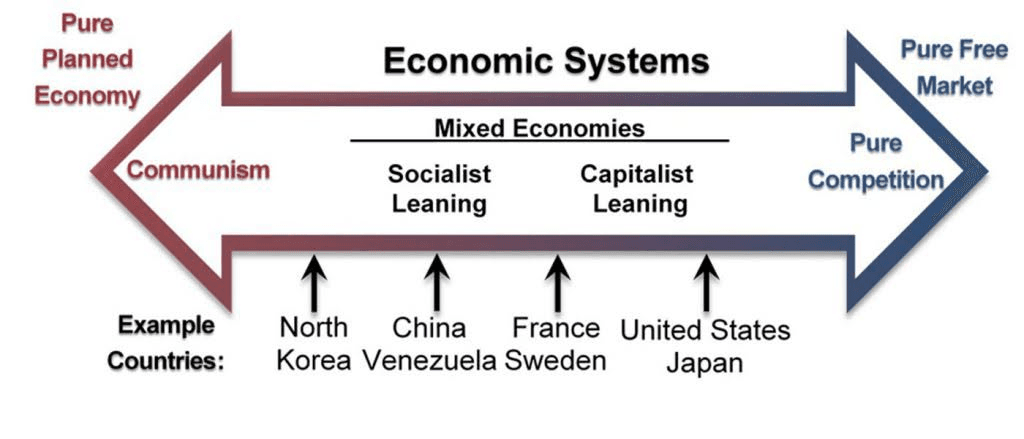
The United States has a mixed economy that leans heavily on free markets and private enterprise. Compared to command economies (where the government controls production and distribution) and traditional economies (based on custom and barter), the U.S. system emphasizes private ownership, competition, and consumer choice.

Other major economic systems include socialism and communism, which prioritize collective or state ownership. The U.S. model allows for government regulation and public goods (e.g., defense, education) while keeping most production and pricing in private hands.
Economic Systems

Fig. 4 The United States economy in relation to other countries economy.

Supply, demand, consumers, producers, and free-enterprise systems

Supply
Supply is the amount of a good or service that producers are willing and able to offer for sale at different prices. Generally, as price increases, supply increases.
Demand
Demand is the amount of a good or service that consumers are willing and able to buy at different prices. Generally, as price increases, demand decreases.
Consumers
Consumers are people or groups that buy and use goods and services to satisfy their wants and needs. In a market economy, consumer choices help determine what is produced.
Producers
Producers are people or businesses that make goods or provide services. They use resources (labor, capital, land) to supply products to the market.
Free-enterprise system
A free-enterprise (or free-market) system is an economic system in which private businesses operate with minimal government control. Prices, production, and distribution are largely determined by supply and demand and by competition.

Videos

Introduction to Supply and Demand

Supply and Demand: Crash Course Economics #4

Producers and Consumers - Exploring How We Buy, Sell, and Use Goods

Producers and Consumers - Exploring How We Buy, Sell, and Use Goods

Free-enterprise systems

Free-enterprise systems

The Bill of Rights

The Bill of Rights

The Bill of Rights, comprising the first ten amendments to the U.S. Constitution, guarantees essential rights and protections to American citizens, including freedoms of speech, religion, and due process.

Video

The Bill of Rights

The Bill of Rights

Three amendments that are important to me

The First Amendment, Second Amendment, and Fifth Amendment are the most important to me. The First Amendment secures my rights to speak freely, write freely, practice the religion of my choosing, and gather freely in a peaceful manner. The Second Amendment allows me to own legally obtained firearms within my household. The Fifth Amendment allows me to stay silent in the presence of the police or authority. Allowing me to stay silent keeps me from saying self-incriminating things.

Importance of the Bill of Rights

What is the importance of the Bill of Rights to the American people?
It provides a legal basis for individuals to challenge government actions that infringe upon their rights, thus playing a vital role in the American legal system.

Works Cited

  1. "The American Revolution: Major Events | SparkNotes." SparkNotes, 2024, www.sparknotes.com/history/american-revolution/events/. Accessed 5 Mar. 2026.
  2. "Bill of Rights | Definition, Origins, Contents, & Application to the States." Encyclopædia Britannica, 11 Jan. 2019, www.britannica.com/topic/Bill-of-Rights-United-States-Constitution. Accessed 4 Mar. 2026.
  3. "Cultural Development - (AP Human Geography) - Vocab, Definition, Explanations | Fiveable." Fiveable.me, 2025, fiveable.me/key-terms/ap-hug/cultural-development. Accessed 4 Mar. 2026.
  4. "Exploration, American Beginnings: 1492-1690, Primary Resources in U.S. History and Literature, Toolbox Library, National Humanities Center." Nationalhumanitiescenter.org, 4 Mar. 2026, nationalhumanitiescenter.org/pds/amerbegin/exploration/exploration.htm. Accessed 4 Mar. 2026.
  5. "Exploring Stories of Cultural Connection: Examples, Interactions, and Reflections - Bending Borders." Bending Borders, 10 Apr. 2025, bendingborders.org/exploring-stories-of-cultural-connection-examples-interactions-and-reflections/. Accessed 4 Mar. 2026.
  6. "Federal Government: Structure, Roles & Functions." FED News Daily, 2024, fednewsdaily.com/federal-government/. Accessed 4 Mar. 2026.
  7. Fiveable. "The Impact of Geography on the History and Development of Texas." Fiveable, 2025, fiveable.me/hs-texas-history/unit-8/impact-geography-history-development-texas/study-guide/Xhq08WiDZycsbl8D. Accessed 4 Mar. 2026.
  8. "Foreign Affairs, New Nation, Early United States." American History Central, 15 Oct. 2024, www.americanhistorycentral.com/entries/new-nation-foreign-affairs/. Accessed 4 Mar. 2026.
  9. "Geography - Linking the Human and Physical Worlds." Encyclopedia Britannica, 4 Mar. 2026, www.britannica.com/science/geography/Linking-the-human-and-physical-worlds. Accessed 4 Mar. 2026.
  10. geosushanta. "Geography of the United States: From Landforms to Cultural Diversity - Geographical Analysis." Geographicalanalysis.com, 10 June 2023, geographicalanalysis.com/geography-of-the-united-states/. Accessed 4 Mar. 2026.
  11. Gittleman, John L. "Adaptation | Definition, Examples, & Facts." Encyclopædia Britannica, 26 Apr. 2018, www.britannica.com/science/adaptation-biology-and-physiology. Accessed 4 Mar. 2026.
  12. Historian, The. "10 Most Important People in the American Revolution." Have Fun with History, 21 Sept. 2022, www.havefunwithhistory.com/important-people-in-the-american-revolution/. Accessed 4 Mar. 2026.
  13. J. Zachary Klingensmith. "Welcome to Economics." Unizin.org, Affordable Course Transformation: the Pennsylvania State University, 26 Aug. 2019, psu.pb.unizin.org/introductiontomicroeconomics/chapter/chapter-1/. Accessed 4 Mar. 2026.
  14. "LibGuides: Primary Sources: America (U.S.A.) History: Early Exploration of North America." Fau.edu, 2018, libguides.fau.edu/primary-sources-america/exploration. Accessed 5 Mar. 2026.
  15. National Park Service. "Civil War Timeline - Gettysburg National Military Park (U.S. National Park Service)." Nps.gov, 6 Oct. 2022, www.nps.gov/gett/learn/historyculture/civil-war-timeline.htm. Accessed 4 Mar. 2026.
  16. "The New Nation, 1783–1815 | Gilder Lehrman Institute of American History." Gilderlehrman.org, 2025, www.gilderlehrman.org/history-resources/essays/new-nation-1783-1815. Accessed 4 Mar. 2026.
  17. "Texas Annexation." History Portfolio, 4 Mar. 2026, thehistoryportfolio.weebly.com/texas-annexation.html. Accessed 4 Mar. 2026.
  18. "Texas Annexation." Wikipedia, Wikimedia Foundation, 29 Dec. 2025, en.wikipedia.org/wiki/Texas_annexation#/media/File:Emory_Map_of_Texas_1844_UTA.jpg. Accessed 4 Mar. 2026.
  19. "Texas Revolution: Facts and Timeline for Kids." www.american-Historama.org, 4 Mar. 2026, www.american-historama.org/1829-1841-jacksonian-era/texas-revolution.htm. Accessed 4 Mar. 2026.
  20. Wikipedia Contributors. "Republic of Texas." Wikipedia, Wikimedia Foundation, 16 Oct. 2019, en.wikipedia.org/wiki/Republic_of_Texas. Accessed 4 Mar. 2026.